Turner AI | The Future of AI Auditing Begins with Better Digital Twins
Jun 27, 2026
Turner AI | The Future of AI Auditing Begins with Better Digital Twins
Manufacturing is entering a new era where artificial intelligence is becoming deeply integrated into production, quality assurance, robotics, and autonomous decision-making. As these systems become more capable, a fundamental question emerges:
How do we know the AI is making decisions within a healthy, well-organized operational environment?
Traditional AI auditing focuses on outputs—evaluating whether an AI system made the correct recommendation, complied with regulations, or remained within predefined constraints. Digital twins have advanced this capability by creating virtual representations of equipment, processes, and production lines.
Yet most digital twins still answer a fundamentally historical question:
What happened?
Turner AI approaches the problem differently.
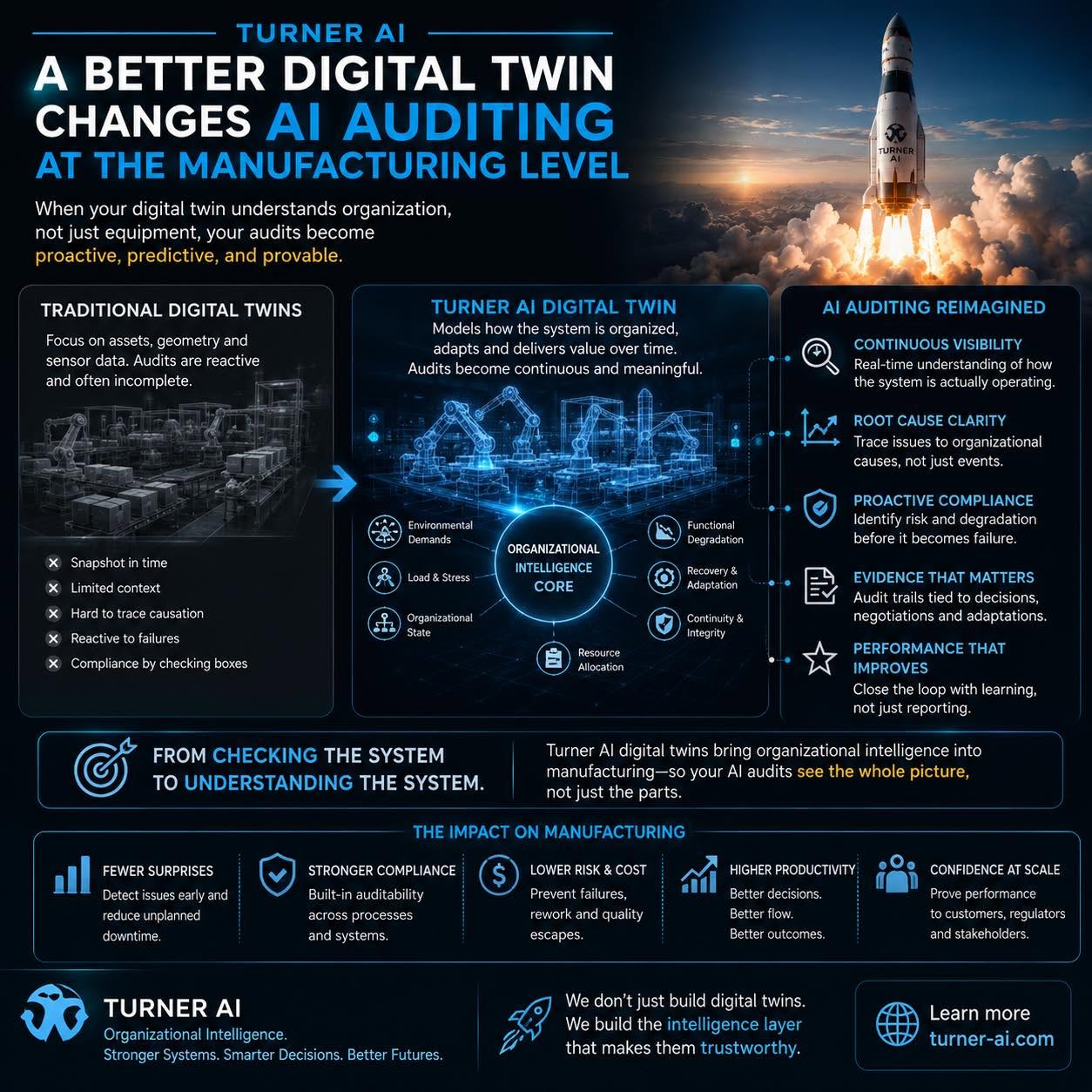
Instead of modeling only machines, sensors, or process flows, Turner AI models the organizational state of an operational system. The focus shifts from isolated assets to the relationships, dependencies, resource allocations, and state transitions that determine how an entire manufacturing environment functions.
This enables digital twins to answer a far more valuable question:
How is the system organizing itself?
That distinction changes the role of AI auditing entirely.
Rather than treating auditing as a periodic compliance exercise, organizational state can be evaluated continuously as operations evolve. AI systems gain awareness of the computational environment in which decisions are being made—not simply the data being processed.
By representing organizational state computationally, manufacturers can begin to understand:
-
How resources are being allocated across complex production systems.
-
Where organizational bottlenecks are emerging before they impact throughput.
-
When functional degradation begins long before equipment failure occurs.
-
How operational changes propagate across interconnected workflows.
-
Which decisions improve organizational efficiency—and which introduce hidden computational or operational waste.
The result is more than a digital representation of a factory.
It is a computational model of how the factory functions.
This shift has important implications for AI governance, predictive operations, and industrial resilience. As manufacturing systems become increasingly autonomous, the quality of AI decisions will depend not only on algorithms and data, but on the quality of the computational model describing the operational environment itself.
Digital twins are evolving beyond visualization.
They are becoming computational platforms for continuous operational awareness.
We believe the next generation of digital twins will not simply represent equipment.
They will represent organization.
Turner AI is building the computational framework that makes that possible.
#TurnerAI #DigitalTwin #AIAuditing #Manufacturing #Industry40 #ArtificialIntelligence #IndustrialAI #DigitalTransformation #PredictiveAnalytics #OperationalExcellence #SystemsEngineering #Innovation